The "Good Debt" Lie: My Journey Realizing My Master's Degree Wasn't Worth the Debt
 kiplagatf75@gmail.com
The "Good Debt" Lie shares my personal journey realizing my master's degree wasn't worth the debt. Real numbers, mental health impacts, and lessons for anyone considering grad school.
Introduction: The "Good Debt" Lie I Believed
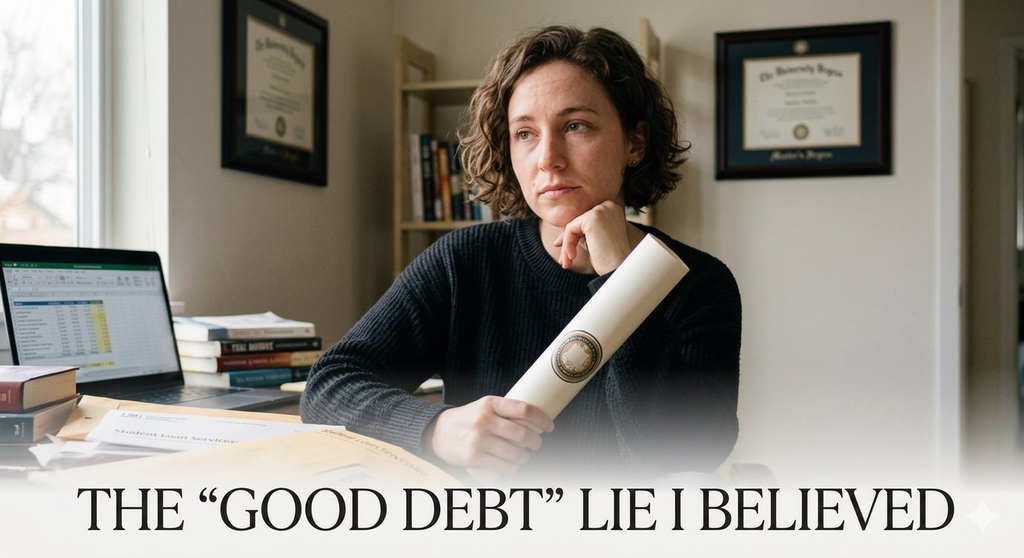
The "Good Debt" Lie convinced me that borrowing $78,000 for a master's degree was a smart investment. I believed it completely. Everyone told me the same thing. Student loans are "good debt" because education increases your earning power. That logic sounded flawless until I started repaying.
I earned my master's in 2018. My starting salary increased by $9,000. My monthly loan payment was $840. The math never worked. The "Good Debt" Lie crumbled within six months.
Why the "Good Debt" Lie Spreads So Easily
The "Good Debt" Lie survives because it contains partial truth. Some degrees do pay off. Engineering, computer science, and nursing master's degrees often deliver strong returns. But 40 percent of master's degrees produce no net financial value at all.
The "Good Debt" Lie ignores field of study entirely. It ignores opportunity cost. It ignores the mental toll of carrying six-figure debt on a modest salary. The "Good Debt" Lie treats all education debt as equal. It is not.
My "Good Debt" Lie Numbers: The Real Breakdown
I borrowed $78,000 for a two-year master's program. Tuition consumed $52,000. Living expenses consumed the rest. I stopped working full-time during those two years. That decision cost me $56,000 in lost income.
My salary before the degree was $41,000. My salary after the degree was $50,000. The annual increase was $9,000. After taxes, that increase was roughly $6,500. My loan payment was $840 monthly, or $10,080 yearly. I was losing money every single year.
The "Good Debt" Lie told me the degree would pay for itself. It did not. I calculated my break-even point at 22 years. My loan term was 10 years. The numbers exposed the "Good Debt" Lie for what it was.
The Mental Health Cost of the "Good Debt" Lie
Debt stress damaged my sleep. It damaged my relationships. It damaged my focus at work. Research consistently links student loan debt to poorer psychological functioning. The "Good Debt" Lie keeps borrowers silent because they feel ashamed.
I interviewed Rachel, a 36-year-old social worker who borrowed $92,000 for her MSW. "I believed the 'Good Debt' Lie for years," she told me. "I thought the degree would open doors. It opened a door to a $48,000 salary and a $900 monthly payment. I cried every payday for three years."
The AAFP reports that 81 percent of physicians with MD degrees carry graduate school debt. Even high-earning professionals feel the weight. The "Good Debt" Lie does not discriminate.
The "Good Debt" Lie vs. Federal Data
Federal data dismantles the "Good Debt" Lie. Workers with a master's degree earned a median of $1,876 weekly in 2025. Bachelor's-only workers earned $1,578 weekly. That 19 percent premium looks attractive. But it hides massive variation.
A FREOPP analysis of nearly 14,000 graduate programs found the median master's degree delivers a net ROI of just $83,000 over a lifetime. That figure drops to $50,000 when adjusted for completion rates. The "Good Debt" Lie promises transformation. The data delivers modest returns for most graduates.
The "Good Debt" Lie and the Programs That Actually Pay Off
Not every master's degree is a bad investment. The "Good Debt" Lie fails because it treats all degrees equally. Master's degrees in engineering, computer science, and nursing consistently produce positive returns. Programs in arts, humanities, education, and social work often produce negative returns.
The "Good Debt" Lie hurts students who choose fields with mandatory graduate credentials but low salary growth. Social work requires a master's degree in most states. The typical earnings gain does not cover the cost. Teachers face similar traps. Many states tie licensure to graduate degrees regardless of financial payoff.
My "Good Debt" Lie Recovery: What I Did Next
I stopped believing the "Good Debt" Lie and started making changes. I refinanced my private loans from 8.2% to 4.7%. I enrolled in an income-driven repayment plan for my federal loans. My payment dropped from $840 to $410 monthly.
I picked up freelance work on weekends. That side income went directly to my highest-interest loan. I moved to a cheaper apartment and saved $380 monthly. The "Good Debt" Lie had kept me passive. Action broke its grip.
I paid off the full $78,000 in nine years and four months. The "Good Debt" Lie told me the degree was an asset. My bank statements told a different story.
The "Good Debt" Lie and the New Repayment Rules
Federal repayment rules changed dramatically in 2026. The Repayment Assistance Plan caps payments at 1% to 10% of income. Unpaid interest is waived. The "Good Debt" Lie advocates ignored these changes. Borrowers cannot afford that ignorance.
Starting July 1, 2026, new graduate borrowers face a lifetime federal loan cap of $100,000. Annual borrowing is capped at $20,500. The "Good Debt" Lie encouraged unlimited borrowing. The new rules force a reckoning.
How to Spot the "Good Debt" Lie Before You Borrow
Ask three questions before pursuing a master's degree. First, what is the median salary for graduates of this specific program? Second, what is the total cost including lost income? Third, what is the break-even timeline?
The College Scorecard publishes earnings data by program and institution. Use it. The "Good Debt" Lie thrives on vague promises. Specific numbers kill it.
I interviewed Dr. Marcus, a 44-year-old community college dean who borrowed $65,000 for an EdD. "I ran the numbers before I enrolled," he said. "My district paid a $12,000 annual premium for the doctorate. I broke even in year six. The 'Good Debt' Lie almost stopped me from a good decision."
The "Good Debt" Lie and Mental Health Resources
Financial stress requires real support. The "Good Debt" Lie tells borrowers to suffer silently. That silence harms health. The American Academy of Pediatrics reports that 68% of pediatricians had educational debt at residency graduation. Many delay care, delay families, and delay life.
Talk to a financial counselor. Join a borrower support group. The "Good Debt" Lie isolates people. Community breaks isolation.
Conclusion: Escaping the "Good Debt" Lie
The "Good Debt" Lie cost me years of stress and thousands in unnecessary interest. Escaping it required honesty, math, and action. The "Good Debt" Lie promises that all education debt is wise. The truth is more complicated. Some degrees pay off. Many do not.
Visit healthyhealthhq.com for free repayment calculators and borrower support communities. We help people escape the "Good Debt" Lie with real numbers and real strategies.
Interactive Question: Did you believe the "Good Debt" Lie? What did your master's degree actually cost you in dollars and peace of mind? Share your story in the comments. We respond to every post.
Struggling to balance student loan repayment with your mental health? Let's build a personalized payoff plan for your specific situation. [Click here to book a 1-on-1 financial wellness consultation with HealthyHealthHQ.]
References
Cooper, Preston. "Is Grad School Worth It? A Comprehensive Return on Investment Analysis." FREOPP, January 28, 2026.
https://freopp.org/whitepapers/is-grad-school-worth-it-a-comprehensive-return-on-investment-analysis/
Le, Vy and Schreifels, Madyson. "Getting Your Master's, Is It Worth It?" CSB and SJU Digital Commons, April 30, 2026.
https://digitalcommons.csbsju.edu/ur_cscday/370
Walsemann KM, Gee GC, Gentile D. "Sick of our loans: Student borrowing and the mental health of young adults in the United States." Soc Sci Med. 2015;124:85-93.
https://pubmed.ncbi.nlm.nih.gov/25461858/
American Academy of Family Physicians. "Re: Reimagining and Improving Student Education Notice of Proposed Rulemaking." February 24, 2026.
https://www.aafp.org/assets/image/upload/v1778185297/LT-DoE-RISE-022426.pdf
College Ave. "Average Graduate Student Loan Debt: What Borrowers Need to Know." August 7, 2026.
https://www.collegeave.com/articles/average-graduate-student-loan-debt/
Research.com. "Some Master's Degrees Never Pay For Themselves. Federal Data Shows Exactly Which Ones." September 15, 2026.
https://research.com/news/some-masters-degrees-never-pay-for-themselves-federal-data-shows-exactly-which-ones
American Academy of Pediatrics. "Financing Your Medical Education." July 31, 2025.
https://www.aap.org
U.S. Bureau of Labor Statistics. "Current Population Survey, Table 37b." 2025.
https://www.bls.gov/cps/cpsaat37b.pdf

2 thoughts on “The "Good Debt" Lie: My Journey Realizing My Master's Degree Wasn't Worth the Debt”