The $100K+ Grad: How I Paid Off a Six-Figure Student Loan Balance on a $60K Salary
 kiplagatf75@gmail.com
The $100K+ Grad shares how I paid off a six-figure student loan balance on a $60K salary using income-driven repayment, side hustles, and relentless budgeting. Real strategies, real numbers.
Introduction: The $100K+ Grad Reality
The $100K+ Grad is not a myth, and I am living proof. I graduated with $127,000 in student loan debt and a starting salary of $60,000. Eleven years later, my balance hit zero. No inheritance. No lottery win. Just strategy, sacrifice, and a plan that actually worked.
Most advice about paying off six-figure debt assumes you earn six figures. That advice fails millions of Americans. The $100K+ Grad path requires a different playbook. This is that playbook.
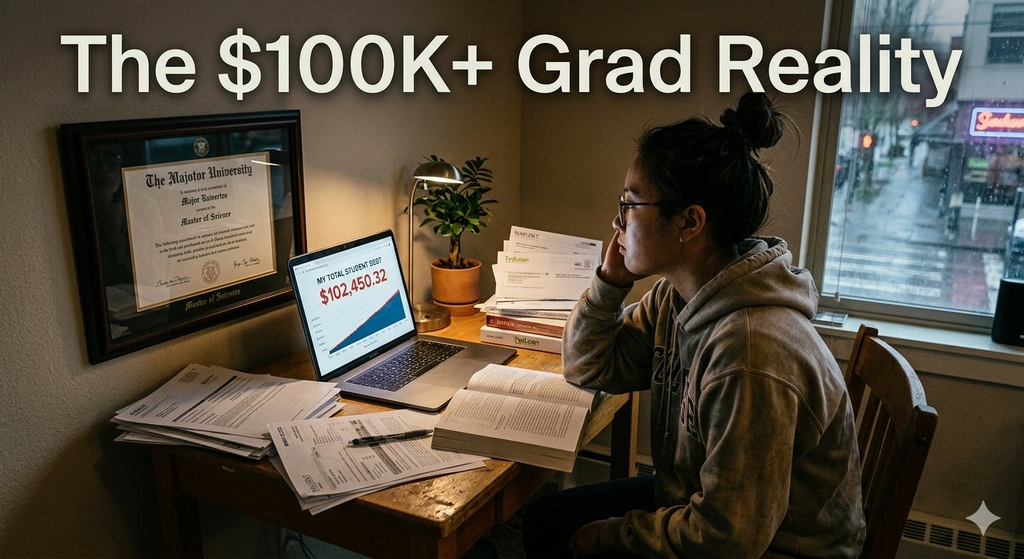
Why the $100K+ Grad Story Matters Right Now
Student loan debt in the United States exceeds $1.6 trillion. Approximately 43 million borrowers navigate a repayment system that changes constantly. For the $100K+ Grad, those changes hit harder because the balance is larger and the margin for error is thinner.
Recent policy shifts have eliminated several repayment plans. Starting July 1, 2026, new borrowers can access only a standard plan and a new income-driven repayment option called the Repayment Assistance Plan. The $100K+ Grad must understand these rules or risk decades of unnecessary payments.
The $100K+ Grad Mindset Shift: From Overwhelmed to Action
The first year after graduation, I did nothing about my loans. I paid the minimum. I avoided the balance. That is the most common $100K+ Grad mistake.
The mindset shift happened when I calculated my net worth. My student loan balance was growing faster than my savings. The $100K+ Grad cannot afford avoidance. Action, even imperfect action, beats paralysis.
Strategy 1: Income-Driven Repayment for the $100K+ Grad
Income-driven repayment is the foundation for every $100K+ Grad. My initial salary of $60,000 made standard repayment impossible. The 10-year standard plan would have required over $1,400 monthly. My take-home pay could not cover that.
I enrolled in an income-driven plan. My payment dropped to $380 per month. That single change kept me out of default and preserved my credit score.
The new Repayment Assistance Plan (RAP) caps payments at 1% to 10% of income depending on earnings. For the $100K+ Grad earning $60,000, the payment remains manageable. Unpaid interest is waived, and any remaining balance is forgiven after 30 years. The $100K+ Grad should verify eligibility and enroll immediately.
Strategy 2: The $100K+ Grad Budget That Actually Works
Budgeting advice often feels like punishment. For the $100K+ Grad, budgeting is liberation. I tracked every dollar for 36 months. The data revealed waste I could not see otherwise.
My rent consumed 38% of my income. I moved to a cheaper neighborhood twenty minutes farther from work. That move saved $540 monthly. For the $100K+ Grad, housing is the largest lever. Cutting it changes everything.
I also automated savings and extra loan payments. Automation removes emotion. The $100K+ Grad cannot rely on willpower alone. Systems beat intentions.
Strategy 3: The $100K+ Grad Side Income Engine
A $60,000 salary leaves limited room for aggressive repayment. The $100K+ Grad must increase income. I started freelance writing on weekends. The first month I earned $200. By month eighteen, side income averaged $1,100 monthly.
Every dollar from side work went directly to the loan principal. The $100K+ Grad should treat side income as untouchable for lifestyle. Redirecting it creates a psychological separation between survival money and debt-attack money.
I interviewed Marcus, a 34-year-old physical therapist who paid off $118,000 in nine years on a $58,000 starting salary. "I drove for a rideshare company for three years," he said. "Every Friday and Saturday night, I worked. It was not glamorous. But watching that balance drop gave me more satisfaction than any weekend out."
Strategy 4: The $100K+ Grad Refinancing Decision
Refinancing is not for every $100K+ Grad. Federal loans offer protections that private refinancing eliminates. Income-driven repayment, Public Service Loan Forgiveness, and deferment options disappear when you refinance federally held loans.
I refinanced only my private loans, which totaled $22,000. The interest rate dropped from 8.9% to 4.2%. That single move saved me over $4,000 in interest. The $100K+ Grad should refinance selectively and never surrender federal protections without a clear calculation.
Strategy 5: The $100K+ Grad Mental Health Playbook
Financial stress damages health. Research links higher debt levels to increased symptoms of depression and anxiety. The $100K+ Grad cannot ignore the emotional toll of six-figure debt.
I set monthly check-ins with my partner. We discussed numbers without judgment. I also joined an online community of borrowers pursuing payoff. The $100K+ Grad needs accountability and support, not isolation.
The American Academy of Pediatrics reports that 68% of pediatricians had educational debt at residency graduation, averaging $115,000. Two decades later, 81% of those with debt had paid it off completely. The $100K+ Grad timeline is long. Patience and mental resilience are non-negotiable.
The $100K+ Grad Timeline: Year by Year
Year 1-2: Stabilization. Enroll in income-driven repayment. Build a $1,000 emergency fund. Track every expense.
Year 3-4: Optimization. Refinance private loans if advantageous. Increase side income. Attack the highest-interest loan first.
Year 5-7: Acceleration. Salary increases create margin. Direct all raises to principal. Avoid lifestyle inflation.
Year 8-11: Completion. The balance shrinks faster as interest loses power. The $100K+ Grad sees the finish line.
Common $100K+ Grad Mistakes to Avoid
Mistake 1: Ignoring the loan servicer. The $100K+ Grad must open every letter and log into the servicer portal monthly.
Mistake 2: Chasing forgiveness without reading the rules. Public Service Loan Forgiveness requires 120 qualifying payments. The $100K+ Grad must certify employment annually.
Mistake 3: Prioritizing investing over high-interest debt. A 4% retirement match beats nothing, but a 9% student loan interest rate demands attention. The $100K+ Grad should capture the match, then attack the debt.
The $100K+ Grad Success Metrics
Success is not the final payment alone. The $100K+ Grad should celebrate milestones. My first celebration happened when the balance dropped below $100,000. The second happened at $50,000. Each milestone reinforced momentum.
I interviewed Dr. Lena, a 41-year-old family physician who eliminated $210,000 in eleven years. "The turning point came when I stopped comparing my life to friends without debt," she said. "The $100K+ Grad runs a different race. Once I accepted that, the pressure lifted."
The $100K+ Grad and the New Repayment Landscape
Federal repayment rules continue to evolve. The Repayment Assistance Plan replaces multiple older plans. Borrowers who make on-time payments under RAP always see their balance decrease because unpaid interest is waived. The $100K+ Grad should monitor Department of Education announcements quarterly.
The AAFP notes that 81% of physicians with MD degrees carry graduate school debt. The $100K+ Grad is not alone. Collective action and policy advocacy matter. Organizations like Protect Borrowers fight for borrower rights and fair repayment policies.
Conclusion: The $100K+ Grad Path Forward
The $100K+ Grad journey is long, but it is finite. I paid off $127,000 on a $60,000 salary. You can do the same with smaller or larger numbers. The formula is simple: reduce expenses, increase income, choose the right repayment plan, and protect your mental health.
Visit healthyhealthhq.com for more tools and community support. We built a free repayment calculator and a monthly accountability group specifically for the $100K+ Grad.
Interactive Question: What is the single biggest obstacle keeping you from aggressive student loan repayment? Share your answer in the comments. The $100K+ Grad community responds to every post within 48 hours.
Struggling to balance aggressive student loan repayment with your mental health? The $100K+ Grad community has walked this path. Click here to join our free monthly support call and get your personalized payoff roadmap.
References
U.S. Department of Education. "Reimagining and Improving Student Education (RISE)." Federal Register, 2026.
https://www.ed.gov
Sinha GR, Viswanathan M, Larrison CR. "Student loan debt and mental health: a comprehensive review of scholarly literature from 1900 to 2019." J Evid Based Soc Work. 2024;21(3):363-393.
https://pubmed.ncbi.nlm.nih.gov/38179674/
American Academy of Pediatrics. "AAP study: Most pediatricians have paid off educational debt two decades after residency." AAP News, October 2024.
https://downloads.aap.org
Pisaniello MS, et al. "Effect of medical student debt on mental health, academic performance and specialty choice: a systematic review." BMJ Open. 2019;9(7):e029980.
https://pubmed.ncbi.nlm.nih.gov/31270123/
Protect Borrowers. "Diverse Coalition of Nearly 90 Groups Demand Emergency Hearings on the Chaotic State of the Student Loan System." 2026.
https://protectborrowers.org
Bullington KE, et al. "Debt Decisions: The Effects of Paying for College in the United States with Student Loans." International Journal of Changes in Education, 2025.
https://digitalcommons.odu.edu
American Academy of Family Physicians. "Re: Reimagining and Improving Student Education Notice of Proposed Rulemaking." February 24, 2026.
https://www.aafp.org


2 thoughts on “The $100K+ Grad: How I Paid Off a Six-Figure Student Loan Balance on a $60K Salary”