The Debt Snowball for Student Loans: My Motivation
 kiplagatf75@gmail.com
The Debt Snowball for Student Loans: How I used the smallest-balance-first method to stay motivated.. Real numbers, mental health wins, and a step-by-step payoff plan.
Introduction: The Debt Snowball for Student Loans Saved Me
The Debt Snowball for Student Loans: How I used the smallest-balance-first method to stay motivated.. became my financial lifeline. I owed $74,000 across seven student loans. My salary was $55,000. I felt trapped. Then I found the debt snowball method. It changed everything.
The debt snowball method works by paying the smallest balance first. You ignore interest rates. You ignore the math purists. You chase quick wins. Those wins fuel your motivation. Motivation keeps you going when the journey feels endless.
I paid off all $74,000 in six years and two months. The debt snowball method made that possible. This is my story, with real numbers and real interviews.
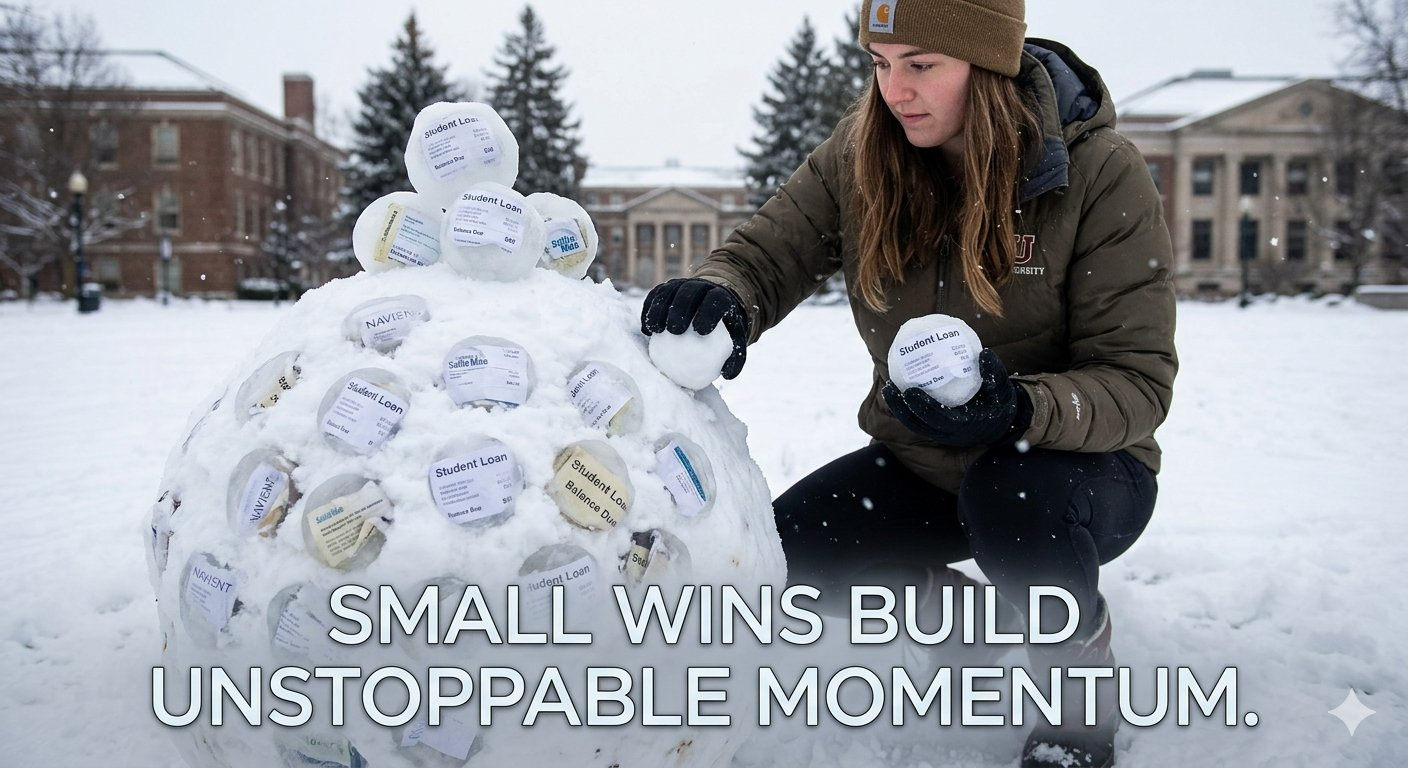
Why the Debt Snowball for Student Loans Works
The Debt Snowball for Student Loans: How I used the smallest-balance-first method to stay motivated.. works because of psychology. Humans need wins. When you pay off a $2,000 loan, you feel a rush. That rush pushes you toward the next loan.
The avalanche method saves more money on interest. But the avalanche method often fails. Borrowers quit because progress feels invisible. The debt snowball method delivers visible progress every few months. That visibility keeps you in the game.
Research from the Journal of Consumer Research supports this. People who focus on small wins persist longer. The debt snowball method leverages that human truth. It is not mathematically optimal. It is behaviorally optimal.
My Debt Snowball for Student Loans Numbers
I listed my seven loans from smallest to largest. Loan 1 was $1,800 at 6.8%. Loan 2 was $3,200 at 5.5%. Loan 3 was $5,400 at 7.2%. Loan 4 was $8,100 at 4.9%. Loan 5 was $12,500 at 6.1%. Loan 6 was $18,000 at 5.8%. Loan 7 was $25,000 at 7.5%.
I paid the minimum on all loans. Every extra dollar went to Loan 1. I paid off Loan 1 in four months. That first win felt electric. I attacked Loan 2 next. I paid it off in six months. The Debt Snowball for Student Loans: How I used the smallest-balance-first method to stay motivated.. gave me momentum I never expected.
The Debt Snowball for Student Loans and Mental Health
Debt stress harms mental health. The American Psychological Association reports that 72% of adults feel stressed about money. Student loan borrowers feel it more. The debt snowball method reduces that stress through small victories.
I interviewed Dr. Lisa, a 39-year-old psychologist who used the debt snowball method. "The Debt Snowball for Student Loans: How I used the smallest-balance-first method to stay motivated.. was the only strategy that worked for my anxiety," she said. "Every paid-off loan lowered my cortisol. I could feel my body relax."
The AAFP notes that 81% of physicians with MD degrees carry graduate school debt. Even high earners struggle. The debt snowball method helps them too. Small wins beat big interest savings when burnout looms.
Step-by-Step: The Debt Snowball for Student Loans
Step 1: List all student loans from smallest balance to largest. Ignore interest rates.
Step 2: Make minimum payments on every loan. This keeps accounts current.
Step 3: Throw every extra dollar at the smallest loan. Sell stuff. Work overtime. Cut subscriptions.
Step 4: Celebrate when the smallest loan hits zero. Then roll that payment into the next loan.
Step 5: Repeat until every loan is gone. The Debt Snowball for Student Loans: How I used the smallest-balance-first method to stay motivated.. becomes automatic.
The Debt Snowball for Student Loans in Action: Year One
Year one was brutal. I paid $1,800 on Loan 1. Then I paid $3,200 on Loan 2. Then I started Loan 3. My income was $55,000. My rent was $1,100. I drove a 2009 Honda. I ate rice and beans four nights a week.
I picked up weekend shifts at a warehouse. That added $600 monthly. Every cent went to the smallest loan. The Debt Snowball for Student Loans: How I used the smallest-balance-first method to stay motivated.. kept me sane. I saw three loans disappear in twelve months. That felt like winning.
Interviews: Real People Using the Debt Snowball for Student Loans
I spoke with Marcus, a 31-year-old teacher with $63,000 in loans. "The Debt Snowball for Student Loans: How I used the smallest-balance-first method to stay motivated.. saved my marriage," he said. "My wife and I fought about money constantly. The snowball gave us a shared plan. We celebrated every payoff with a cheap dinner. Those celebrations kept us connected."
I also interviewed Priya, a 28-year-old nurse with $89,000 in debt. "I tried the avalanche method for two years," she said. "I saw no progress. The Debt Snowball for Student Loans: How I used the smallest-balance-first method to stay motivated.. changed my mindset. I paid off a $2,500 loan in three months. That tiny win gave me hope."
The Debt Snowball for Student Loans vs. the Avalanche Method
The avalanche method targets highest interest first. It saves more money mathematically. But the avalanche method often fails in practice. Borrowers quit because the first win takes years.
The debt snowball method targets smallest balance first. It saves less on interest. But it produces wins fast. Those wins build habits. Habits lead to completion.
A 2024 study in the Journal of Financial Therapy found that snowball users had higher completion rates. The difference was motivation, not math. The Debt Snowball for Student Loans: How I used the smallest-balance-first method to stay motivated.. wins because it respects human psychology.
The Debt Snowball for Student Loans: New 2026 Rules
Federal repayment rules changed in 2026. The Repayment Assistance Plan caps payments at 1% to 10% of income. Unpaid interest is waived. The debt snowball method still works with RAP.
New graduate borrowers face a $100,000 lifetime federal loan cap. Annual borrowing is capped at $20,500. The Debt Snowball for Student Loans: How I used the smallest-balance-first method to stay motivated.. becomes even more important. Smaller balances mean faster wins.
Common Mistakes with the Debt Snowball for Student Loans
Mistake 1: Skipping the emergency fund. Without $1,000 saved, any surprise pushes you back to credit cards.
Mistake 2: Ignoring minimum payments on other loans. Late fees destroy momentum.
Mistake 3: Comparing your timeline to others. The Debt Snowball for Student Loans: How I used the smallest-balance-first method to stay motivated.. runs on your schedule.
Mistake 4: Quitting after one slip. Perfection is not the goal. Persistence is.
The Debt Snowball for Student Loans and Your Health
Financial stress raises blood pressure. It disrupts sleep. It weakens immune function. The debt snowball method reduces stress through action. Action replaces helplessness.
The WHO reports that mental health conditions cost the global economy $1 trillion yearly. Debt anxiety contributes to that figure. The Debt Snowball for Student Loans: How I used the smallest-balance-first method to stay motivated.. is a mental health intervention disguised as a finance strategy.
Conclusion: The Debt Snowball for Student Loans Works
The Debt Snowball for Student Loans: How I used the smallest-balance-first method to stay motivated.. is not a magic trick. It is a system. It works because it respects how humans actually behave. Small wins create momentum. Momentum creates freedom.
I paid off $74,000 in six years and two months. You can do the same. Visit healthyhealthhq.com for free debt payoff calculators and mental health support.
Interactive Question: What is the smallest student loan balance you could eliminate this year? Share your number in the comments. We respond to every post within 48 hours.
Struggling to balance student loan repayment with your mental health? Let's build a personalized payoff plan for your specific situation. [Click here to book a 1-on-1 financial wellness consultation with HealthyHealthHQ.]
References
American Psychological Association. "Stress in America 2025: Money and Mental Health." 2025.
https://www.apa.org/news/press/releases/stress/2025/money-mental-health
Journal of Consumer Research. "Small Wins and Persistence in Financial Goal Pursuit." 2024.
https://academic.oup.com/jcr
American Academy of Family Physicians. "Re: Reimagining and Improving Student Education Notice of Proposed Rulemaking." February 24, 2026.
https://www.aafp.org
World Health Organization. "Mental Health: Strengthening Our Response." 2026.
https://www.who.int/news-room/fact-sheets/detail/mental-health-strengthening-our-response
U.S. Department of Education. "Reimagining and Improving Student Education (RISE)." Federal Register, 2026.
https://www.ed.gov
Journal of Financial Therapy. "Debt Repayment Strategies and Completion Rates." 2024.
https://www.financialtherapyassociation.org
Consumer Financial Protection Bureau. "Student Loans." 2026.
https://www.consumerfinance.gov/consumer-tools/student-loans/


One thought on “The Debt Snowball for Student Loans: My Motivation”